While location, purchase price, and timing remain among the primary factors driving real estate investments, another criterion that is gaining importance is how the property is managed after purchase. Developers and hospitality-focused real estate firms, including Oikos Property Developments, have observed an increase in investor interest in how the asset operates.
In tourism-driven markets, this trend is even more evident. A well-located property may initially attract attention, but long-term performance often depends on the overall guest experience, operational consistency, and the quality of day-to-day management.
This is one reason professionally managed hospitality assets are gaining more interest worldwide, including in Greece.
So, what Is Branded Hospitality Management?
Branded hospitality management refers to properties that operate under the standards, systems, or management structure of an established hospitality brand or hotel operator.
In practice:
- Standardized Service Procedures: Ensuring every guest receives the exact same high level of care.
- Professional Maintenance: Preventative and immediate technical support to keep the asset in pristine condition.
- Hospitality-Focused Experience: Tailored guest relations that go beyond simple accommodation.
- Operational Oversight & Quality: Continuous monitoring to eliminate friction and maintain the brand’s reputation.
Why Operational Quality Matters More Than Ever
Today’s guests are not only looking for accommodation. They are looking for reliability, consistency, cleanliness, responsiveness, and a smooth overall experience.
Key Insight: A property’s reputation is its most valuable currency.
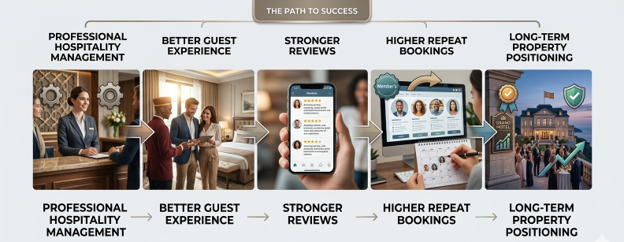
This structural consistency is precisely what influences guest satisfaction, online reviews, repeat bookings, and overall property reputation over time.
| Operational Feature | Independently Managed Properties | Professionally Managed Assets (Branded) |
| Service Consistency | May vary based on individual decisions | Clear, automated systems & strict procedures |
| Issue Resolutions | Operational issues may take longer | Immediate, structured troubleshooting |
| Guest Experience | Highly unpredictable | Reliable, standardised & high-quality |
How Hospitality Management Can Influence Long-Term ROI
Strong hospitality management does not automatically guarantee higher returns.
However, operational quality can influence several factors that contribute to long-term property performance.
For example, professionally managed assets may benefit from:
- potentially stronger occupancy levels,
- more efficient day-to-day operations,
- improved guest satisfaction,
- repeated bookings
- better maintenance standards,
- and more consistent property presentation.
These factors can help support the long-term positioning of an asset within the market.
For international investors especially, professionally managed hospitality properties may also create a more practical ownership experience. Many buyers prefer investments that do not require constant involvement in operational issues, guest communication, or maintenance coordination.
As a result, hospitality-managed assets are often viewed as a more “hands-off” investment approach compared to fully self-managed rental properties.
Why International Hospitality Brands Impact Investor Confidence
One of the reasons why reputable hospitality operators matter is trust.
Foreign investors entering a new market could be greatly influenced by the reputation of the real estate property.
A property connected to internationally recognized hospitality standards may feel more structured, transparent, and reliable compared to a completely independent operation.
That does not mean branding itself brings value. But it can affect how investors, guests, and future buyers perceive the property over time.
In practice, collaborating with internationally recognized hospitality operators could also increase confidence in the process and operational efficiency. Oikos Property Developments collaborates with globally recognized hospitality brands, such as Best Western and Wyndham, in some of their hospitality projects.
Why This Trend is Relevant in Greece
International tourists continue to show high interest in visiting Greece, and the local hospitality sector has evolved significantly in recent years.
Cities like Athens are experiencing ongoing transformation through infrastructure upgrades, urban redevelopment, and increasing international visibility.
At the same time, investor preferences are also shifting.
Many buyers today are not simply looking for standalone real estate assets. Increasingly, they are searching for professionally managed properties that combine ownership with operational support and hospitality expertise.
This growing demand for managed hospitality assets is one of the reasons branded hospitality management is becoming a more relevant conversation within the Greek real estate market.
Final Thoughts
Real estate investment is no longer only about owning property.
For many investors today, the operational ecosystem behind the asset plays an increasingly important role in long-term value and overall ownership experience.
Professionally managed hospitality properties may not guarantee stronger returns, but they can offer something many modern investors value highly: consistency, structure, and operational support.
And in evolving tourism markets like Greece, those factors are becoming more important than ever.